Know the People Behind the Mission: Our Team Spotlight
A conversation with Turhan Kimbrough on agentic autonomy, enterprise adoption, and the human element behind government modernization.
November 12, 2026
As modern enterprises and federal agencies, grapple with an accelerating wave of generative AI, the challenge is rarely just about adopting newer tools. Instead, it is about deploying them responsibly, securely, and effectively within complex operational ecosystems. At Saber-Tech, spearheading that transition falls to Turhan Kimbrough, the company’s Director of AI Engineering.
A seasoned full-stack developer with deep expertise in generative AI integration, Kimbrough holds both a Bachelor of Science and a Master of Science in Computer Science from Towson University. Today, he operates at the intersection of hands-on software development and high-level artificial intelligence strategy.
In this spotlight, Kimbrough discusses his dual role at Saber, the evolving shift toward autonomous agents, and why solving public sector challenges requires far more than writing clean code.
Q: You wear multiple hats at Saber Technology Solutions, supporting both client missions and internal innovation. How do those responsibilities break down day-to-day?
Turhan Kimbrough: On the customer side, I serve as a lead developer supporting an application dedicated to aggregating and curating multi-source data for critical reporting and analysis. A major focus right now is driving generative AI adoption within that environmen —specifically developing Model Context Protocol (MCP) integrations and leveraging AWS enterprise tools like Amazon Bedrock and Quick.
Internally, as Director of AI Engineering, I lead the technical roadmap and implementation for Saber’s flagship product, SCANR (Security Aggregation Network Resource), which uses generative AI alongside security classification guidelines to recommend classification markings. I oversee the design, prototyping, and deployment of its core capabilities.
A big part of my role is continuous R&D. Recently, I built a prototype demonstrating an auditable decision-making framework using System One models with TypeSafe’s Jev. Across both tracks, I stay deeply involved in the code while briefing capabilities to everyone from frontline developers and end-users to executive leadership.
Q: Looking across the broader landscape of artificial intelligence, what emerging trends or questions are capturing your attention right now?
Kimbrough: I am closely watching when and how we will begin moving away from strict “human-in-the-loop” paradigms. Enterprise AI remains heavily reliant on direct human review to catch hallucinations, but consumer-facing AI agents—like Meta’s Muse—are quickly reshaping trust. They are taking on real-world actions, from booking travel to handling purchases.
Even though systems still ask for a final confirmation before a payment goes through, delegating sensitive transactions to autonomous software marks a massive psychological shift. My curiosity lies in the ripple effect: as everyday users grow comfortable with agentic autonomy at home, how fast will that trust carry over into the enterprise workforce and mission-critical workflows?
Q: Government technology often faces a reputation for moving slowly. What is one misconception about gov tech you wish the wider industry understood?
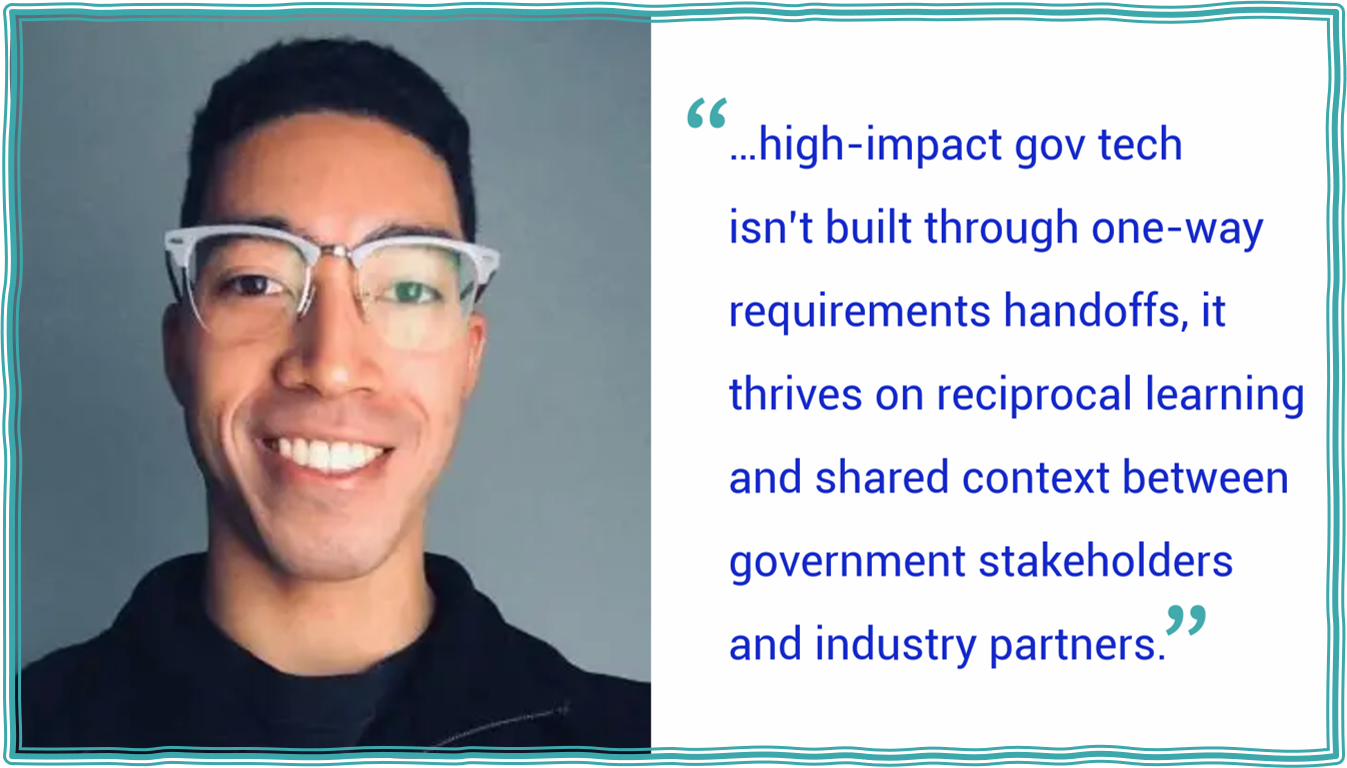
Kimbrough: That impactful gov tech cannot be built through one-way requirement handoffs. Real success requires reciprocal learning and deep shared context between agency stakeholders and industry partners. In government agencies, institutional knowledge is frequently siloed across offices, programs, and mission areas.
The hardest engineering hurdle is rarely writing the software itself; it’s connecting organizational dots so the system addresses the actual problem. Contractors and technology partners have to invest the time up front to understand the operational nuances, mission constraints, and policy landscapes they are building for.